
AGROECOLOGY ACTION COLLECTIVE
The Agroecology Action Collective is a group of organisations and farmer networks in South Africa working and advocating together to transform the food system through agroecology.
We believe food is more than production – it is community, culture and sovereignty. By sharing knowledge, building solidarity, and driving collective action, we work to strengthen agroecology as the pathway towards socially just and sustainable food systems.
PARTNER ORGANISATIONS
Implementing partners:
Association for Rural Advancement (AFRA) www.afra.co.za
Biowatch South Africa www.biowatch.org.za
Environmental Monitoring Group (EMG) www.emg.org.za
Surplus People Project (SPP) www.spp.org.za
Trust for Community Outreach and Education (TCOE) www.tcoe.org.za
Participating organisations and networks:
Eastern Cape and Mpumalanga Water Caucuses
Ilizwi Lamafama
Land Network National Engagement Strategy (LandNNES) www.landnnes.org
Mopani Farmers’ Association (MFA)
Rural Women’s Assembly (RWA) www.ruralwomensassembly.org
Sovereign Agroecology for Food Empowerment (SAFE)
WHY AGROECOLOGY?
Agroecology is so much more than a farming practice that respects nature. It connects grassroots communities, farmers, researchers, workers and consumers in a global movement for food sovereignty to transform our food system to one that is socially just, resilient and sustainable.
Agroecology builds food sovereignty and livelihoods while empowering communities to mitigate and adapt to climate change.
To learn more about agroecology in action and in policy, click through to partner websites (see above) for a wide selection of resources, publications and materials.
THE 13 PRINCIPLES OF AGROECOLOGY
The 13 Principles of Agroecology were developed in 2019 by the UN Committee on World Food Security (CFS) High Level Panel of Experts (HLPE).
The principles should be understood in the context of agroecology as a science, a practice, and a movement. Scientifically, agroecology is rooted in the fields of agronomy and ecology. As a movement, agroecology seeks a fundamental transformation of food production and food systems based on collective agency. As a practice, agroecology is based on working with nature for sustainable food production.
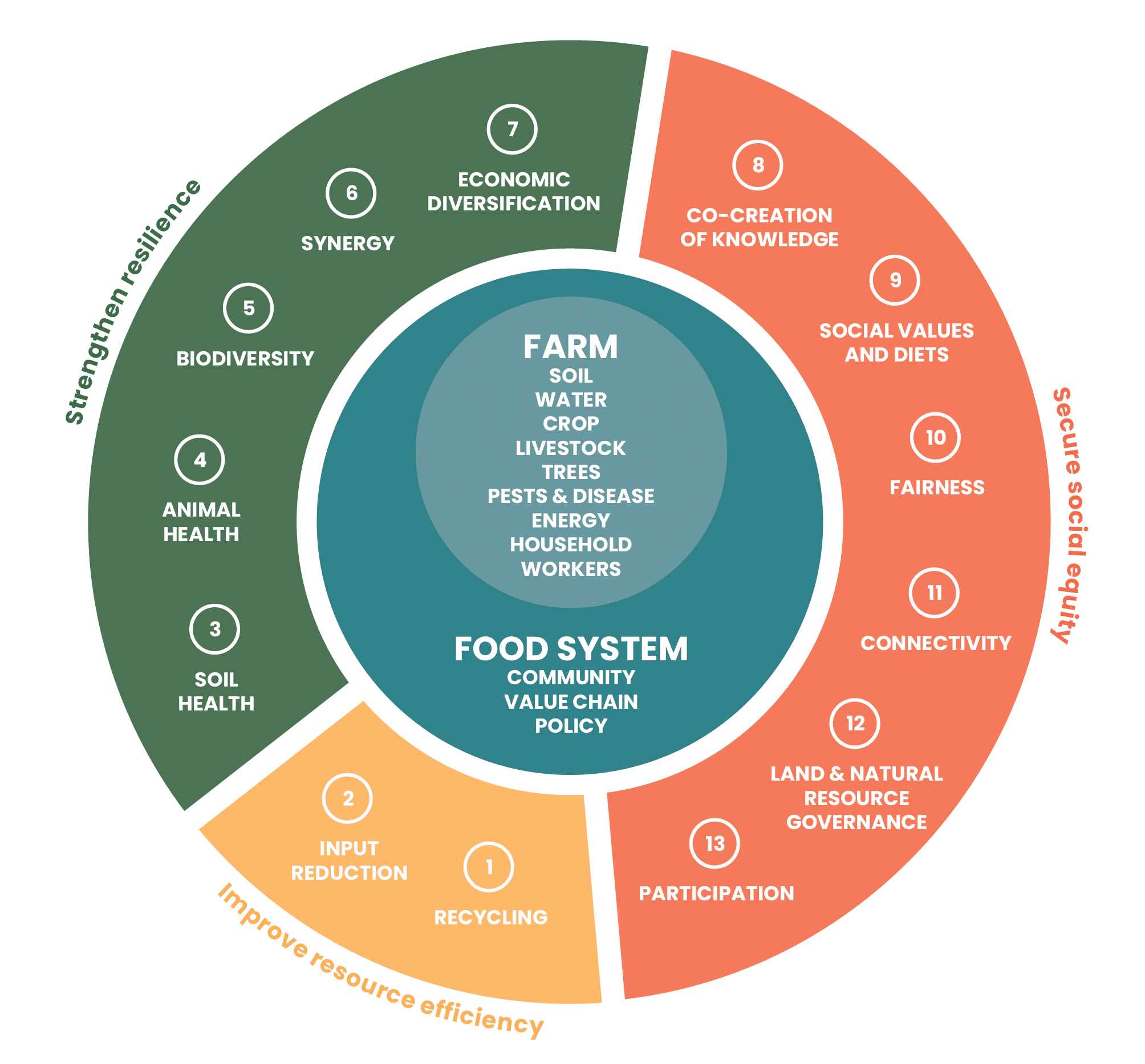
The HLPE’s agroecology principles prioritise:
- Recycling: Fostering local resource cycles and closing nutrient and biomass loops to reduce waste.
- Input reduction: Minimising or eliminating reliance on externally purchased agricultural inputs.
- Soil health: Protecting and enhancing soil health through managing organic matter and biological activity.
- Animal health: Ensuring the health and well-being of livestock within agroecosystems.
- Biodiversity: Maintaining and increasing the diversity of species, functional traits, and genetic resources at all levels of the agroecosystem.
- Synergy: Enhancing positive interactions and complementary relationships between different components of the agroecosystem, such as plants, animals, and soil.
- Economic diversification: Promoting diverse income streams for small-scale farmers to increase their financial independence and opportunities for value addition.
- Co-creation of knowledge: Integrating global science with local and indigenous knowledge to foster innovation and effective problem-solving.
- Social values and diets: Promoting equitable food systems and healthy, culturally appropriate diets.
- Fairness: Ensuring that social and economic justice is embedded within food and agricultural systems.
- Connectivity: Establishing connections between food producers and consumers, and integrating food systems at local and regional levels.
- Land and natural resource governance: Promoting responsible and equitable governance of land and natural resources.
- Participation: Encouraging active involvement and collective decision-making by all stakeholders in the food system.
To learn more about agroecology in action and in policy, click through to partner websites (see above) for a wide selection of resources, publications and materials.